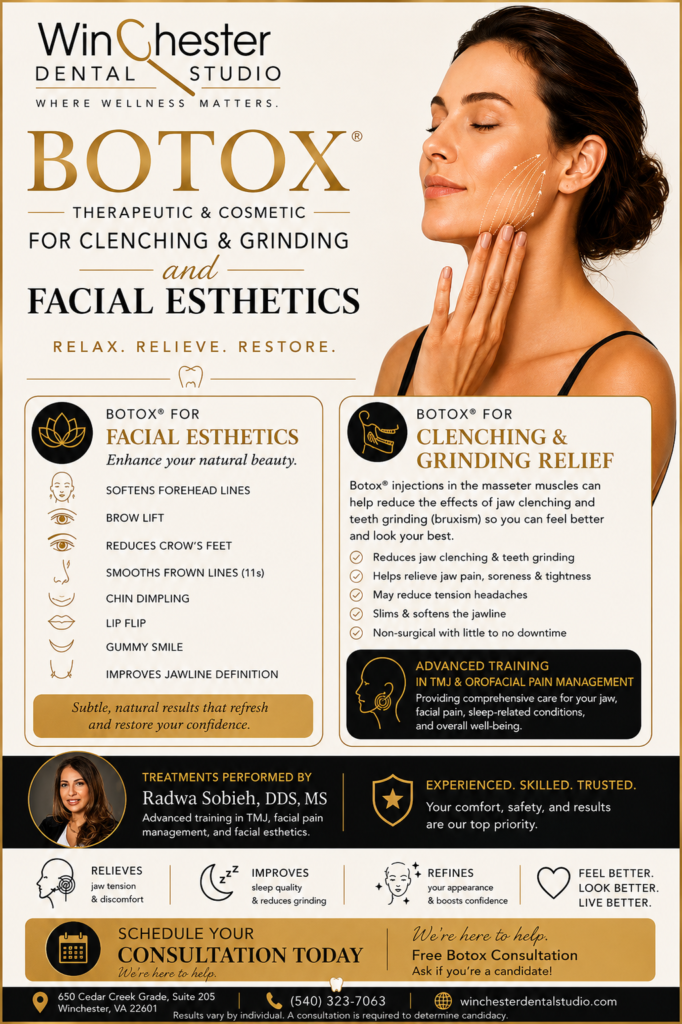
Botox® at Winchester Dental Studio can provide both therapeutic and cosmetic benefits. By carefully targeting specific facial and jaw muscles, treatment can help relax overactive muscles associated with jaw tension, clenching, and grinding, while also softening expression lines and creating a more balanced, refreshed appearance.

For many patients, these benefits naturally overlap; one thoughtfully planned treatment may help improve both comfort and appearance.

Treatment is provided by Dr. Radwa Sobieh, who holds a Master of Science in Temporomandibular Disorders (TMD) and Sleep Apnea from the University of Minnesota, at our office at 650 Cedar Creek Grade Ste 205, Winchester, VA 22601, serving Winchester, Stephens City, Stephenson City, Boyce Town, Clear Brook, Gainesboro, Hayfield, Nain, White Hall, and Round Hill, Virginia.

BOTOX

How Overactive Muscles Affect Both Your Comfort and Your Appearance

If you wake up with a sore or tired jaw, tension headaches, or notice your teeth wearing down, you may be clenching or grinding without even realizing it. The masseter muscles, the powerful muscles responsible for chewing, can become overactive and contribute to jaw tension, clenching, grinding, and certain TMD-related symptoms.

Over time, these same muscles may also become enlarged, giving the lower face a wider or more square appearance. One muscle can contribute to two concerns: discomfort and facial shape. Carefully relaxing an overactive masseter may reduce muscle tension and the forces placed on the teeth, while also creating a softer, more balanced appearance in appropriate patients.

A similar principle applies to the upper face. The muscles responsible for frowning and raising the eyebrows repeatedly contract throughout the day, gradually creating lines between the brows and across the forehead. Precisely placed Botox® can soften this muscle activity, smoothing expression lines while maintaining a natural, expressive appearance.

Botox® can be more than a cosmetic treatment. When thoughtfully planned for the individual patient, it can address both function and appearance, helping you feel more comfortable while still looking naturally like yourself.

Botox® Benefits Include

Many patients first come to us because of jaw pain or teeth grinding. As the overworked jaw muscles relax, they also notice their lower face looks more defined and more balanced. Others come in wanting their forehead lines softened and mention, almost in passing, that they clench all day at their desk, and leave with both addressed.

Whichever reason brings you in, the primary goal is always improving comfort and function. For many patients, the aesthetic improvement is a welcome bonus. Non-surgical, with little to no downtime, it’s a quick, comfortable in-office visit.

Therapeutic Benefits

  • Less jaw pain
  • Reduced clenching and grinding
  • Fewer tension headaches
  • Less pressure on teeth and existing dental work
  • Better muscle relaxation
  • Improved sleep for patients whose grinding was disturbing it

Cosmetic Benefits

  • Softer, more defined jawline
  • Reduced bulky masseter muscles
  • Improved facial symmetry, where appropriate
  • Smoother forehead lines, frown lines, and crow’s feet
  • A more balanced, refreshed appearance

Why Have a Dentist Administer Botox®?

Botox® is injected into the muscles of the head and face. That is the exact region a dentist trains in for years and then works in every day.

  • Facial anatomy is core dental training. The muscles, nerves, and blood vessels of the head and neck are studied in depth in dental school and applied daily thereafter.
  • Precise facial injections are routine. Delivering local anesthetic accurately and comfortably in the face is a skill dentists practice constantly.
  • The bite gets evaluated too. Jaw pain often has a dental cause: an uneven bite, a failing restoration, worn teeth. A dentist can find it. A med spa cannot look for it.
  • Specific TMD expertise. Dr. Sobieh holds a Master of Science in Temporomandibular Disorders (TMD) and Sleep Apnea from the University of Minnesota School of Dentistry, a graduate degree in jaw pain and sleep-disordered breathing.
  • Treatment can be combined. Botox® can be planned alongside a night guard, TMD caresleep apnea therapy, or cosmetic dentistry in one coordinated plan.
  • Virginia sets a training standard. Dentists in Virginia must complete accredited training, including supervised hands-on treatment of live patients, before administering botulinum toxin for cosmetic purposes.

Where Botox® Can Help

Depending on what you want to achieve, treatment may involve one area or several. These are commonly combined in a single visit rather than chosen between:

What to Expect During The Treatment

  • A consultation first. Nothing is injected before your anatomy, medical history, medications, and goals have been reviewed, and you have the plan and the fee in writing.
  • A short, comfortable visit. A very fine needle, a handful of seconds per injection point, and no sedation required.
  • Little to no downtime. Most people go straight back to work. Stay upright for about four hours, avoid rubbing the area, and skip strenuous exercise that day.
  • A gradual, temporary result. The effect builds over about two weeks and wears off over several months. Nothing is permanent.
  • A two-week review. We check how your muscles responded and refine the dose for next time.